

We “separate ecosystems from cities, conservation from development, and water from food, even though none of these systems functions independently,” wrote Kurt Ackermann in a Daily Maverick article. “The result is fragmented governance at precisely the moment when integrated thinking is most needed.”
Kurt, CEO of the South African Urban Food & Farming Trust (SAUFFT), expanded on this message in his introduction to SOLVE’s Food Indaba panel discussion. Systems thinking was at the heart of our exploration of a provenance consideration that has gained traction globally: a holistic approach to growing food, also known as regenerative agriculture.
In the interests of shared understanding, we asked our panel to explore what the term should mean in the context of the V&A Waterfront. Are we referring to farming practices and ecological impact only, or should our thinking extend to resilience of farmers, and the broad social consequences of different agricultural approaches? Are we asking the right questions – is it even possible to farm at scale leaving chemicals off the table and applying the principles of regenerative practices? Looking at the food chain from where it starts in the soil and ends on our plates, how should the V&A engage – or, should we engage at all?
WHAT DO WE MEAN BY ‘REGENERATIVE AGRICULTURE’?
From the dawn of industrial farming in the 1950s until the late 90s, significant damage was done to agricultural land through extractive farming methods. A regenerative approach goes further than simply seeking to maintain things as they are, instead seeking to proactively restore and enhance ecosystems. In farming, this starts with improvement of soil, reducing the need for chemical additives. Healthier soil retains water better, and produces crops of superior flavour and nutritional value. Over time, farms become more resilient and generate more and better produce; farmers reduce costs, risks and uncertainty; and you and I see delicious benefits on our plates. Other benefits range from the environmental, such as carbon sequestration and drought resilience, to the social, such as food security and community empowerment.
Across South Africa, the approach is gaining traction as a climate-smart response to environmental assaults. Spokespeople like Andrew Ardington, Founder of RegenAg SA, and Angus MacIntosh of Spier frame soil restoration not just as an environmental choice, but as a commercial and ecological necessity for a climate-vulnerable country. Woolworths’ Farming for the Future initiative has demonstrated the viability of the approach, with produce from both small-scale and commercial farmers contributing to a mainstream shift.
South Africa is echoing a global trend. The regenerative sector is predicted to roughly double in value globally in the five years to 2027, driven in part by consumer consciousness, but equally by farmers’ drive to reduce input costs, and by government incentives for carbon sequestration.
WHY SHOULD THE V&A WATERFRONT TAKE AN INTEREST?
Let’s take a step back.
As a 123ha precinct which is privately-owned but operates as a public space the V&A Waterfront is effectively a mini-city. It is home to 100+ eateries ranging from snack shops and food trucks to award-winning fine dining restaurants. These draw their patrons from the ±25 000 people who either live or work at the Waterfront, and the ±26 million visits made to the precinct each year. This makes the Waterfront a central hub in Cape Town’s food ecosystem. It also makes it an excellent sandbox in which to test solutions to systems and ecosystems problems, which it does with purpose. In-progress or already implemented projects include, for instance:
The Sustainable Seafood initiative is a great prototype. In 2022, we set out to find out whether as an ecosystem, the Waterfront’s food activities could shift the needle on ocean health. Four years later, on July 2 this year, we launched Cape Catch, a programme that highlights locally caught, traceable, certified fish on menus, making it easy for diners to make sustainable choices. What, we had asked over the journey, does the term “sustainable seafood” mean to the V&A restaurant ecosystem? What would it take to shift restaurants to feature sustainable options more prominently? Could suppliers meet the demand in a way that was price-equivalent, and gave restaurants the certainties they needed? And were restaurant patrons even concerned about this?
The answer was: yes. If we made it easy, everyone – patrons, suppliers, chefs – would be willing to shift. That’s what Cape Catch does: makes it easy to source, order and enjoy sustainable species. As we roll it out, we will be collecting critical data and hope, in about 18 months time, to be able to report a meaningful shift away from problematic practices to a greater market share of sustainable practices.
Regenerative farming is the land-based equivalent of sustainable seafood, sharing a core philosophy that food production must not only avoid harm, but must actively restore the environment on which it depends.
OUR INTENTION WITH THE REGENERATIVE AGRICULTURE INITIATIVE
With its critical mass of eateries, the V&A is looking to “sandbox” whether:
If these things can be achieved, our theory of change, as with Cape Catch, holds that participating restaurants will increase their standing relative to non-caring restaurants, and will enjoy greater resilience and success. It flows that the example thus set will encourage other V&A restaurants, and other precincts across Cape Town, South Africa and the wider world, to adopt similar value systems, thus in time shifting the value chain towards principles that are kinder to the earth.
OUR PANEL DISCUSSION
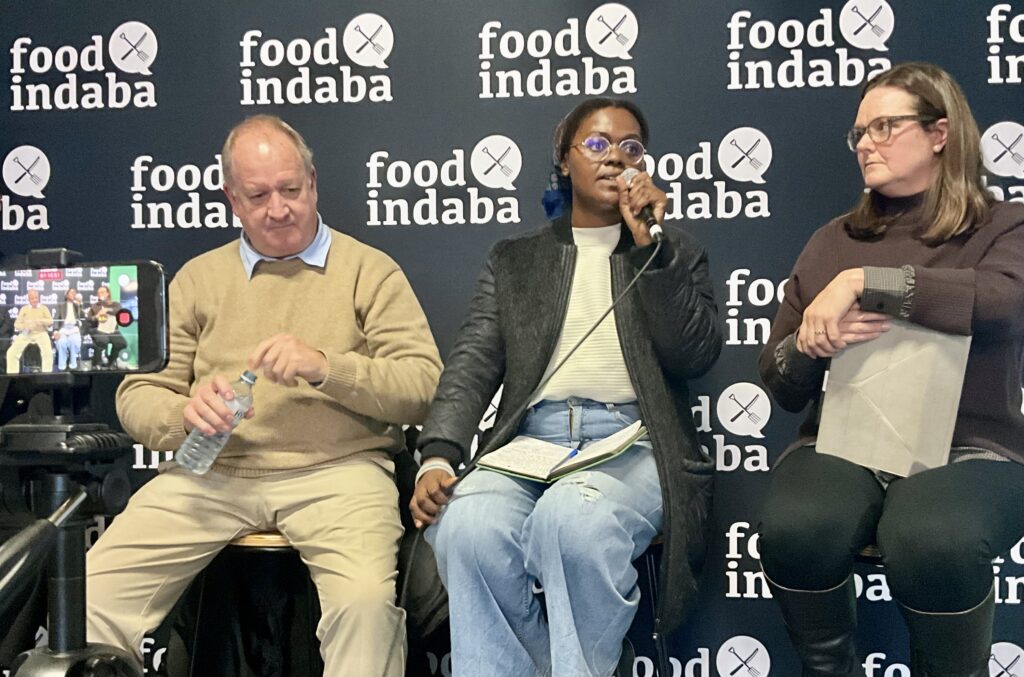
Our kickoff panel discussion, facilitated by Daily Maverick’s Zukiswa Pikoli (DM covered the discussion here), included Kobus Pienaar, Woolworths’ Farming for the Future lead; agro-ecologist Rirhandzu Marivate from SAUFFT, and restaurateur and food activist Rejeanne Vlietman from Den Anker.
Kobus framed the regenerative agriculture movement as a privilege. “The food system has chosen to neglect biodiversity and our friends in the soil,” he said. “We’re privileged to work in a space where we focus on the quantifiable impact of farmers’ decisions on the soil – its chemistry, water needs, biodiversity; its carbon mitigation footprint.”
He’s wary of labels. “The biggest downfall of certification is that there is one rule for everyone,” he said. “But every farm is different. [Farming for the Future] works per farm on the embedding principle: the farmer, the surrounding community, the farmworker, the factory worker. The system is highly complex. Changes can lead to unintended consequences; we learn as we go from mistakes.
“And so, after 20 years, we are still learning what regenerative agriculture is, definitively.”
Apart from customers, the major stakeholders in our investigation will be the farmers themselves, and restaurant buyers and chefs.
The farmer’s perspective: Farmers know the market is relentless. When you’ve priced your carrots at R10 and the wholesale market says it’s R5, farmers will not be able to sell even into their own communities, the panel noted. And, “more nutritious food [from more holistic farming practices] is often the more expensive,” Rirhandzu pointed out. So a starting point is for small-scale farmers to become competitive contributors to the food value chain, while themselves being able to afford to enjoy its benefits. Our definition of “regenerative farming”, thus, definitively extends to the lives and livelihoods of farming communities.
Government policy and programmes, however, are not specifically supportive of emerging farmers, who tend to adopt more traditional and thus more regenerative practices. “The intention is to transform small-scale farmers into commercial conventional farmers,” Rirhandzu said, “rather than addressing their realities.” These realities include, among all the usual considerations such as rainfall predictability, things like access to market. A small farmer may rely on public transport, for instance, with no access to cold chain maintenance.
And so, organisation is key. “Farming is about scale,” said Kobus. “Organisation allows small farmers to achieve economic units.” Organisation and aggregation – Woolworths is able to sell regeneratively farmed produce at the same price as industrially-farmed options, and that’s partly because it has about a million hectares in its local footprint of Farming for the Future, and the benefits of soil improvement have come through.
The restaurant’s considerations: Aside from price considerations, professional kitchens tend to be highly focused on three things: reliable deliveries of the quantities they need, consistency of quality, and convenience.
“The challenge is the appetite of chefs to make the difference,” confirmed Rejeanne. “They might love the idea – many do – but they struggle with issues of availability, quality, consistency. That’s where large producers have the edge: they are likely to have the ability to better service restaurants.” Aggregators have a real advantage: they have efficient ordering and billing systems, and sophisticated logistics.
Rejeanne believes, however, that restaurants would find value in exploring more: for the previous 18 months, Den Anker had been working with small farmers to better understand the challenges, and how to overcome them. “It’s been a journey to get my team to buy into the pilot, to earn their trust in this alternative system. Who is going to save us, come December, when the farmer lets us down and we don’t have what we need to put in the pots? That’s the anxiety chefs sit with,” she said.
“There are so many barriers but if we don’t try, we’ll never learn. The change has to start with our intentions. If we become part of a movement in a small way, the public will come along. The time is now.
“If you can poke that nerve in people, they will respond.”
NEXT STEPS
“We’re in a food system crisis,” Kobus said. “If we want solutions, we need to look at every stakeholder and role player in the commercial space, share the knowledge, and build agriculture.
“Just imagine if we could get the SADC to be a regenerative hub; we could feed the world! The question is: do we want to do it?”
The V&A Waterfront can play its small part in this, testing the system and finding some solutions. That will start with data: in order to fully understand the landscape, SOLVE will over the next months meet with as many Waterfront restaurants as we can to gather data on where they procure their ingredients, what their top considerations are, and how much of what currently makes its way into our kitchens comes from regenerative sources. What we learn in that process will inform the way forward.
Watch this space!
ABOUT SOLVE@Waterfront
SOLVE @Waterfront is the V&A Waterfront’s urban innovation platform, designed as a living laboratory that brings together businesses, researchers, government and civil society to develop, test and scale solutions to urban challenges.
ABOUT FOOD INDABA
The FOOD INDABA is an annual programme of talks and events that focus on the food system. It brings growers, academics, activists and other stakeholders around issues intimately connected to the food we eat, and the future of food.