
Time Left to Enter
Ready to take your circular innovation to the next stage?
The Circular Innovation Challenge 2026 is looking for innovative Southern African businesses with solutions ready for testing, implementation or scaling. If you are reducing waste, keeping materials in use, or regenerating nature through circular principles, this is your opportunity to accelerate your impact.
At the same time, the challenge aims to promote social inclusion, create jobs, and enhance wellbeing by designing systems that benefit people and the planet.
We are looking for circular solutions across sectors including; Agriculture, Construction, Energy, Manufacturing, Packaging, Technology, Food Systems, Fashion & Textiles and Waste & Resource Management to name a few.
The Circular Innovation Challenge is not simply funding a business. It is about identifying, celebrating and elevating circular economy businesses that deserve greater visibility, stronger connections and opportunities to scale their impact. If you are building a circular business ready for its next stage of growth – we encourage you to apply.
Application process
All entries to the Circularity Challenge must be submitted by using the online application form.
Before submitting your entry, please ensure that:
Important dates
View or download the pdf version of the challenge manual HERE
Ready to turn your circular innovation into real-world impact?
With the support of the V&A Waterfront and The Vikãra Institute, SOLVE@Waterfront is calling for innovative solutions to address waste challenges in Southern Africa through circular principles.
Eligibility
You should enter if:
How we support our finalists?
Winner’s package
Terms and Conditions
View the full terms and conditions here.
Some of the things we will be looking at in the judging process include:
Impact and vision
Business model
Technology
What do we mean by circular innovation?
The Circular Innovation Challenge is seeking solutions that help eliminate waste and pollution, keep materials at their highest value, and regenerate nature. Explore the principles below and discover how the V&A Waterfront is already putting circular thinking into practice through its operations, partnerships and innovation initiatives.
The circular economy has three core principles:
We are seeking entries of products, technologies and/or services which encourage the move from a linear to a circular economy. Our vision is a future in which everyday items such as textiles and plastics, food production and construction materials, and byproducts of living such as waste and blackwater, are produced, consumed, and/or managed in a circular and regenerative manner. Our vision, thus, is a world in which resources are conserved, waste is minimised, and ecosystems are preserved, leading to a thriving and sustainable society.
If you are based in Southern Africa (Angola, Botswana, Lesotho, Mozambique, Namibia, South Africa, Eswatini, Zambia, Zimbabwe) and have developed an innovative solution that meets the definition of circularity, and have at least a prototype ready for testing, we encourage you to make use of this opportunity to grow and develop your network and your business.
What opportunities are available in circularity?
The “10 Rs” ladder of circularity is a useful reference, indicating as it does the principles of circularity. These “Rs” are, in order:
The model below by Circularise shows the opportunities available across the product life cycle. As opposed to the linear economy model of production and consumption we have lived with so far, a circular economy involves the 10 Rs and ensures the use of materials and products for “as long as possible”. This aims to reduce our use of the world’s resources, cut down waste generation, and ultimately diminish carbon emissions, while also making products and goods accessible to people.
Companies can work towards a circular economy in many ways: they can extend the useful life of any product by conserving materials, using sharing economy platforms, offering products as a service, increasing the lifetime of a product by rethinking the product’s design, increasing durability, allowing for repairing and maintenance, as well as dismantling and finally recycling (source: https://divaenvitec.com/).
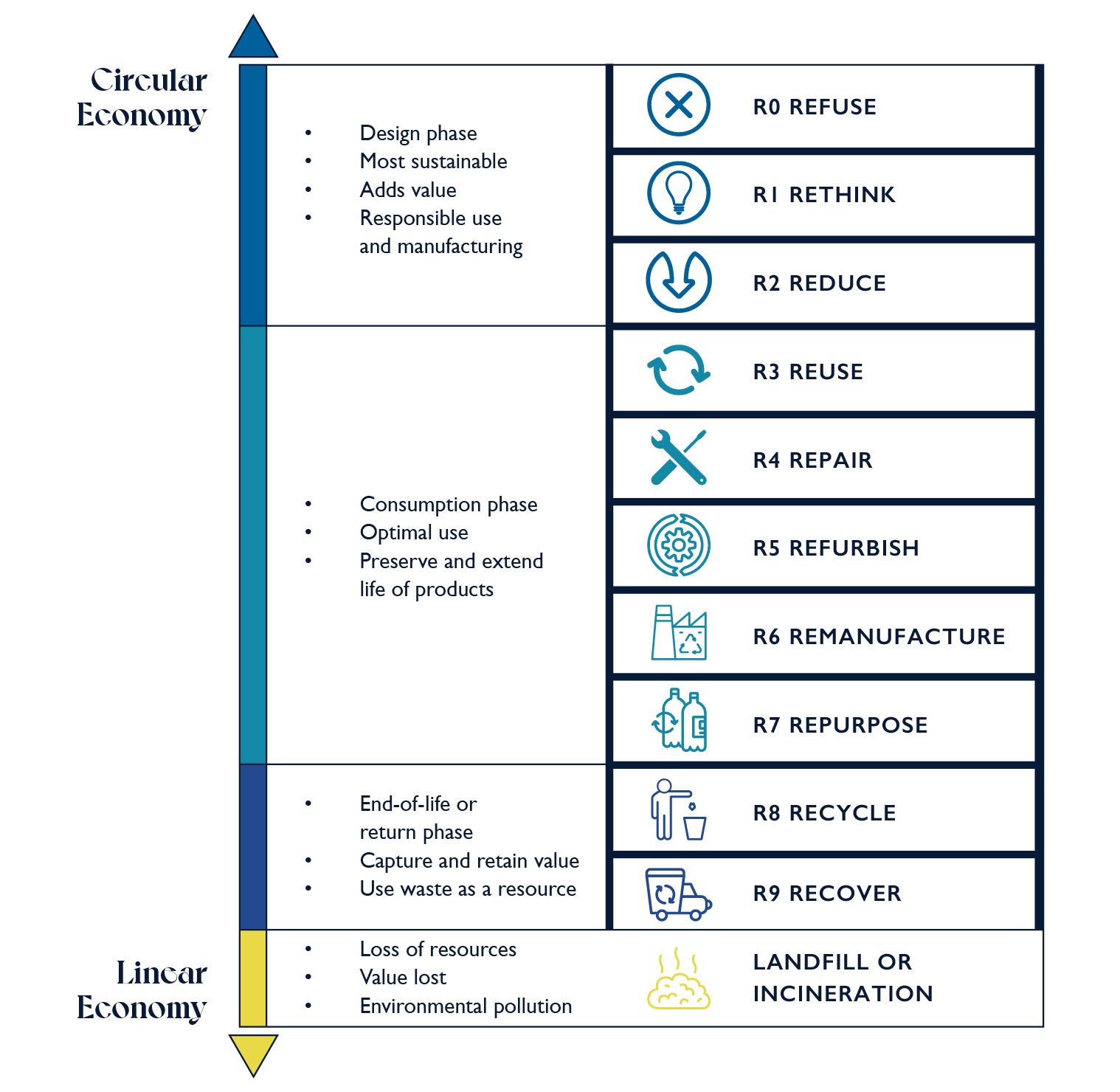
Source: Circularise.com
Practical examples:
For reference and inspirational purposes, we’re sharing some examples of the work the V&A Waterfront already does as part of its commitment to advancing the circular economy agenda. There are many more examples of valid circular activity, but these examples show some existing practical actions, partnerships, and community engagements which contribute to a more sustainable and resilient urban environment. For the winner of our Challenge, these and other initiatives and partnerships can be enlisted in appropriate ways:
| Case Example: STRATEGIC OBJECTIVE for V&A Waterfront | Case Example: PRIORITY ACTION for V&A Waterfront |
|---|---|
| Waste reduction and resource efficiency – textiles, organic waste, plastics, glass, paper, etc |
|
| Collaboration and ecosystem development |
|
| Consumer engagement and education |
|
| Innovation and thought leadership |
|
If you have any challenges with the submission process, please email Rozitta at rdevilliers@waterfront.co.za
View or download the pdf version of the challenge manual HERE