

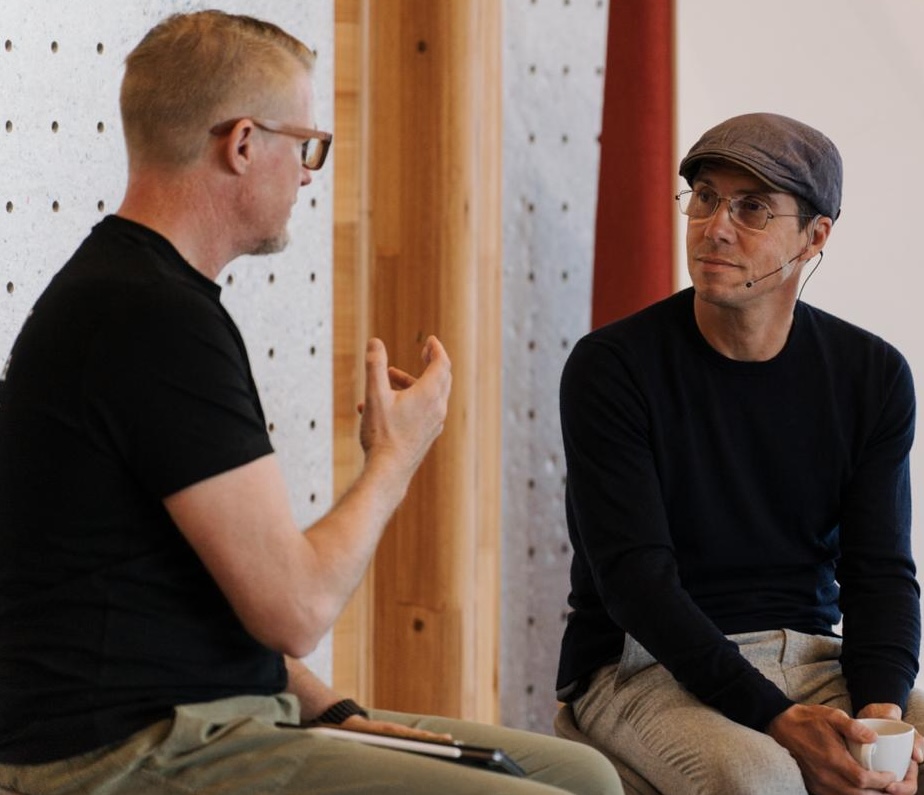
Heavy Chef’s Fred Roed (left) in conversation with his colleague Mike Perk (right) at the final V&A Learning Lunch for 2026, held in the Exhibition Pavilion.
For some, the answer arrives with certainty and conviction from an early age, guiding the course of their lives and careers. For others, purpose is something discovered over time through experience, setbacks and reinvention. It can emerge through the work we do, through an intentional search for meaning, or through the many different paths we take before finding one that truly resonates.
For entrepreneurs, the question of purpose often takes on another dimension. Beyond building a profitable business, many business owners find themselves searching for deeper meaning in the work they do. Why do they do what they do? What problem are they solving? Who are they serving? What impact do they want to leave behind?
It was this line of questioning that shaped the final V&A Waterfront Learning Lunches series in May 2026. The session, titled People & Purpose, brought together small business owners from across the V&A Waterfront neighbourhood to explore agile leadership, meaningful culture and what it takes to build organisations where people can thrive.
Led by Heavy Chef’s Fred Roed (left in the photo above) and Mike Perk (right), the discussion unpacked a topic that is becoming increasingly important in an AI world: the connection between people and purpose.
Purpose starts with the founder
To open the discussion, Mike reflected on a defining moment early in his career, while working in Human Resources, during a period of organisational restructuring at a global retailer. During that time of retrenchments, he witnessed first-hand the emotional impact on employees whose careers, financial security and futures were suddenly disrupted.
The experience left a lasting impression on him and sparked a series of questions that would shape much of his thinking around purpose and the role it plays in our working lives:
Purpose, he pointed out, is often misunderstood as a branding exercise or a carefully crafted mission statement. In reality, it plays a practical role, acting as an anchor during periods of uncertainty and helping both leaders and employees navigate change without losing sight of the bigger picture.
It therefore cannot simply be manufactured and inserted into a business strategy. “Purpose has to come from the founder and then be woven into the business,” Mike said. Purpose defines where an organisation is going, while values and culture determine how people show up every day in pursuit of that vision.
Why social capital matters more than ever
One of the most compelling ideas to emerge from the session was the importance of social capital: the trust, collaboration and shared knowledge that enable a business to adapt quickly.
Mike contrasted traditional business structures, where information often sits with one person at the top making all the decisions, with organisations that succeed by encouraging knowledge to move freely across teams. “These organisations understand that their ability to succeed, adapt, innovate, move and change quickly in the modern world is down to how knowledge flows without restrictions within the business,” he said. He added that organisations need to function less like rigid machines and more like living organisms, constantly learning, evolving and responding to change.
When employees feel connected to a shared purpose, trust one another and care about the success of the business, they become active participants in its growth and adaptability.
The adaptability advantage
With businesses facing rapid technological advances, economic uncertainty, artificial intelligence and shifting cultural expectations, Fred turned the conversation to how leaders should make sense of change through the lens of purpose.
Adaptability starts with understanding what drives human behaviour, Mike said. Some common negative drivers include:
Purpose, however, offers something different. Mike described purpose as a lighthouse: it remains constant, even when the route towards it changes. He added that when people are connected to a compelling purpose, they become less attached to a specific path and more willing to adapt, experiment and innovate in pursuit of the broader vision.
This idea feels particularly relevant today. Markets change. Technology changes. Customer expectations change. Businesses that remain fixed in their methods risk becoming irrelevant, while those that stay committed to their purpose but flexible in their approach are better positioned to navigate uncertainty.
Mike also emphasised that this applies to businesses of every size. Whether you are a multinational running a large-scale operation or a small business with only a handful of employees, long-term success depends on the ability to keep adapting.
One thinks of Nokia, often referenced as a powerful example of this lesson. Once a dominant force in the mobile phone industry, its decline demonstrates how quickly past success can lose its value when an organisation struggles to respond to a changing environment.
As Charles Darwin is often paraphrased, survival depends less on being the biggest or strongest and more on being the most responsive to change. The same principle applies in business.
People before skills?
The conversation then shifted to one of the most common challenges faced by business owners: the hiring process.
Is it better to hire for skill or cultural fit?
Mike’s answer leaned towards the human qualities that enable teams to thrive. Given the choice between a highly skilled individual who negatively impacts team dynamics and a less experienced candidate who is curious, engaged and eager to learn, he would, he said, choose the latter.
His reasoning was simple: skills can often be taught, but attitude, curiosity and a willingness to contribute positively to a team are far more difficult to develop.
Fred agreed, noting that both business and life are long journeys. The people we choose to travel with matter. The energy, collaboration and trust within a team often outweigh the value of any single technical skill.
To illustrate the point, Fred referenced Jim Collins’ bestselling book Good to Great and the concept of “getting the right people on the bus”. Collins argues that organisations succeed not only because of their vision, but because they have the right people working together towards it.
The lesson for business owners was clear: adaptability is not only a strategic advantage, but also a people advantage.
What happens when businesses get people and purpose right?
As the discussion ended, Mike reflected on what happens when organisations successfully align people, purpose and culture.
The first sign is simple: people look forward to coming to work.
Beyond that, businesses become more innovative. Employees feel safe enough to challenge ideas, share perspectives and engage in healthy debate. Different viewpoints lead to stronger decisions, greater commitment and, ultimately, better results. Mike added that creating psychological safety allows people to bring more of themselves into their roles. Rather than operating strictly within the confines of a job description, they begin contributing ideas, solutions and opportunities that extend beyond their immediate responsibilities.
When people feel empowered, businesses benefit from greater creativity, stronger collaboration and increased ownership across the organisation.
Offering a practical example from her own business, Tiffany Marx of Tiffany Marx Jewellery at the Watershed shared how she recently began involving her retail staff more actively in business discussions by inviting their opinions, ideas and suggestions. The result was a noticeable shift in engagement and ownership. Her employees felt more invested in the success of the business because they felt heard and valued.
The discussion highlighted an important leadership shift: moving from managing people and circumstances to coaching people and unlocking their potential.
A final reflection
Perhaps the strongest message from the session was that people are not simply resources to be managed.
When individuals feel connected to a meaningful purpose, empowered to contribute and safe to share their ideas, businesses become more adaptable, innovative and resilient.
In a world defined by constant change, purpose is no longer just a motivational concept. It is a strategic advantage.
And while technology, markets and business models will continue to evolve, one thing remains constant: organisations that invest in their people, create strong cultures and unite teams around a shared purpose will always be better positioned to navigate whatever comes next.
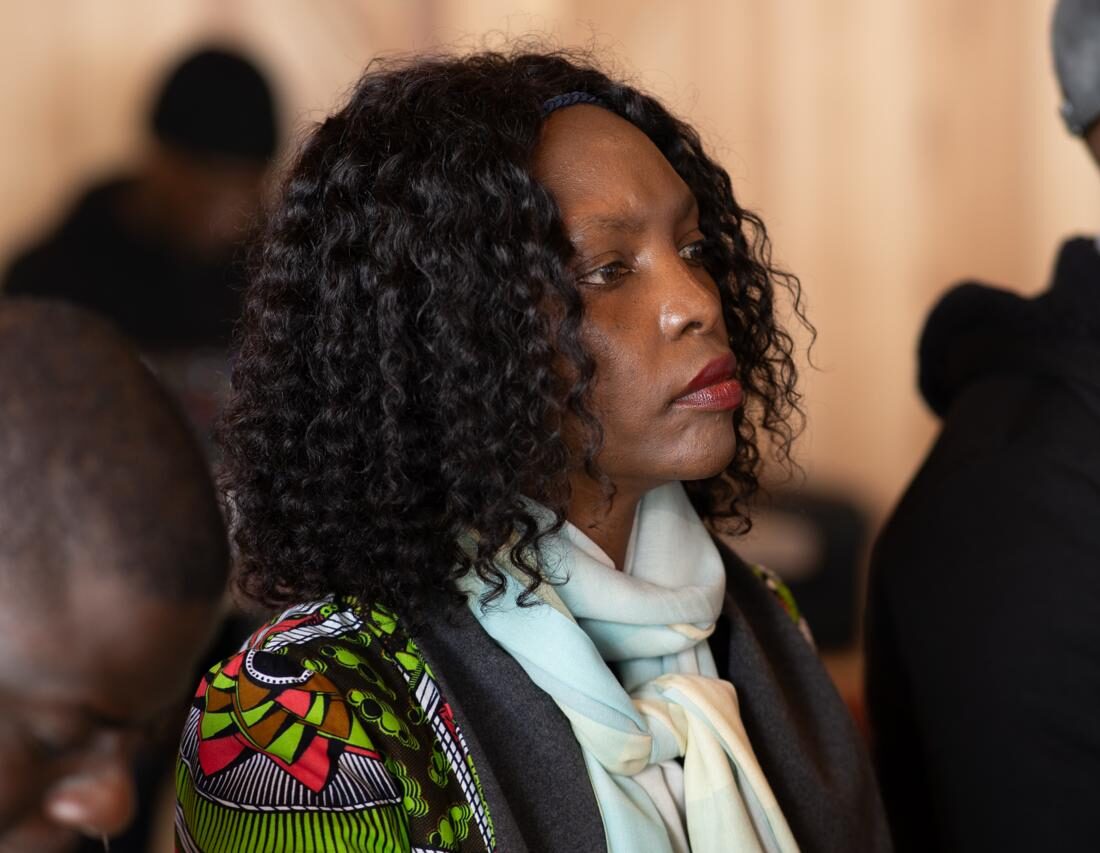
An attendee absorbs the conversation at the final SMME Learning Lunch for 2026.
ABOUT THE SMME CLUSTER:
SMMEs work in a famously challenging social and economic environment. The V&A Waterfront’s SMME Cluster, which drives the Learning Lunches, is about establishing a mutual support system for SMMEs in our network, and working together around shared challenges and opportunities. Our goal: a more resilient, innovative and flourishing SMME community.
ABOUT HEAVY CHEF
Heavy Chef is a learning community for entrepreneurs (the name comes from the saying “never trust a skinny chef”). It aims to inspire entrepreneurs to start, then empower them to succeed. It runs learning programmes for hundreds of entrepreneurs each year, and has a community of 50,000+ entrepreneurs. V&A Waterfront’s Learning Lunches are among its programmes.