

“Imagine,” Dr Judy Mann-Lang asked her audience, “if we could support healthy oceans through our seafood choices.
“Imagine if our seafood choices could support local businesses and communities.
“Imagine if our restaurants could sell delicious, desirable seafood at a price that makes the business thrive.
“Imagine if seafood suppliers could source and sell sustainable seafood that meets the demands of the restaurants…”
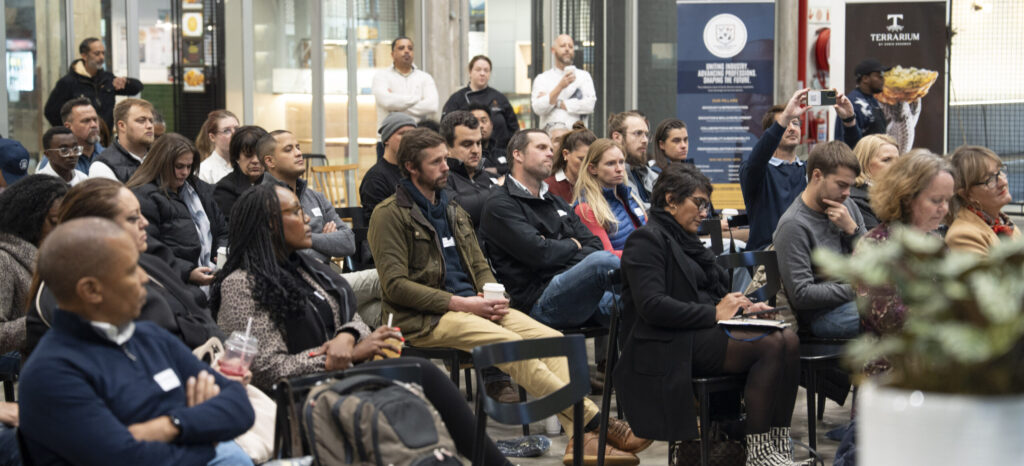
At the 2026 edition of the Sustainable Seafood panel discussion, on July 2nd, attendees saw the dream beginning to take life. It’s taken years of conversations, compromises and commitment to get to this point, but – to quote Judy’s final “imagine” – the V&A Waterfront has taken a decisive step towards becoming the best place in Africa for delicious, local and sustainable seafood.
THE JOURNEY SO FAR
Over the last four years, the V&A Waterfront’s process of discovery involved interviewing chefs, fishers, seafood suppliers and more than 1 000 visitors to the Waterfront; and it involved analysing menus and international best practice. We’ve held panel discussions with specialists, activists and practitioners – you can review those discussions here, here and here.
It’s been an often surprising journey. Our menu analysis told us, amongst other things, that most of the seafood sold in V&A restaurants is imported, and much is not from sustainable sources. Read that against the fact that up to 70% of the hake caught in South African waters is exported, and it’s clear the system is flawed. To nudge our Waterfront restaurants into more sustainable offerings, everybody would have to play their part – fishers, suppliers, buyers, chefs, and restaurant patrons.
But our research also gives us some good news: across the value chain, people are interested in doing the right thing. It’s just that sustainable seafood is complicated. Please, said buyers, chefs and restaurant patrons – make selecting sustainable seafood easy, and we’ll do it.
HOW WE HAVE MADE IT EASY
Welcome to Cape Catch, our way of making it easy.
Cape Catch is a list of seafood items that are:
Cape Catch items, in other words, are from sustainably managed fisheries, support local communities or businesses, are versatile, and can be sourced in the volumes, and at the price and times, that chefs need them.
To join the programme, V&A Waterfront restaurants firstly select from this list items that they have or will carry on menus. After verifying their legitimacy (i.e. checking provenance with their supplier), they “badge” those items on menus to help patrons identify Cape Catch choices.
To assist restaurants in getting up to speed, the V&A is offering training for chefs, managers and waitrons, and has developed targeted information packs.
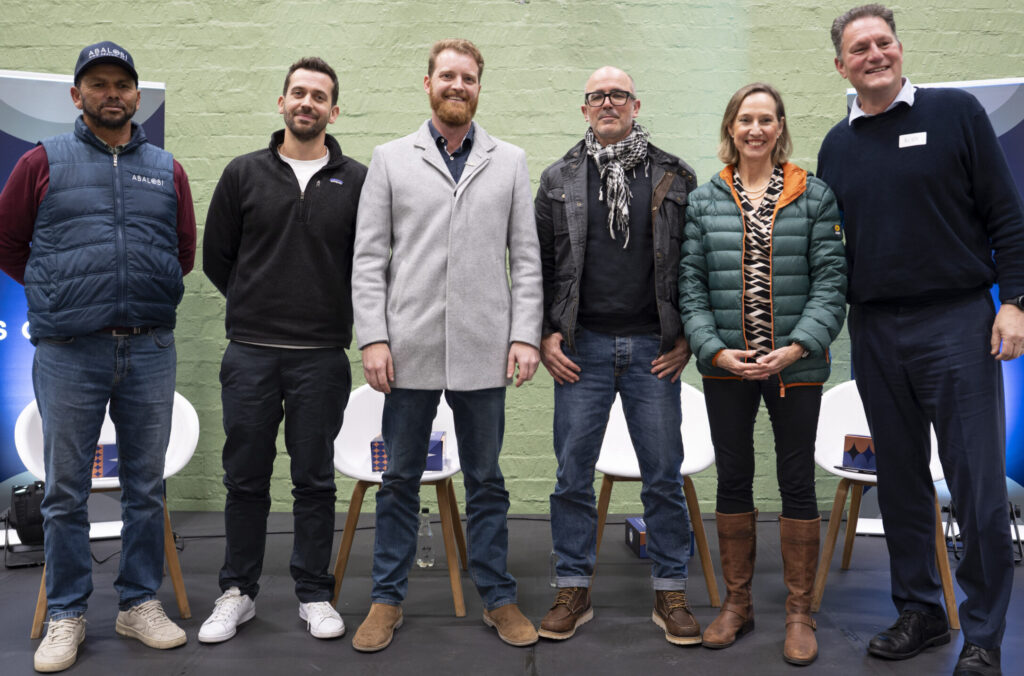
We’re confident the bulk of the thinking work is behind us, and that we’ll soon see a meaningful shift to more sustainable species, and so we set out to pressure test Cape Catch with a panel of experts before an audience of about 60 stakeholders. On the panel, we had multi-award-winning Chef Ryan Cole from Coy and Salsify; Marco Coelho from Ocean Basket; Kurt Hill from supplier Cape Fish; and Hahn Goliath, a fisher representing supplier Abalobi. The V&A’s retail executive Alex Kabalin completed the panel.
DOES THE CAPE CATCH LIST WORK FOR RESTAURANTS?
Yes, said Ryan, whose restaurants cater to a refined market. The list covers the bases; and the species meet seasonality needs. “There is something for all of us to latch on to and learn from and grow,” he said. “Now we must commit.”
And yes, said Marco. Ocean Basket operates in the value space, and during Covid began the work of reconfiguring the value chain to reflect more locally caught fish. “The challenges are real,” he said; “The last thing I want is complex supply chains from across the world.”
In 10 years, he added, the predictability of availability has changed; shortages require restaurants to be more bold. “It took me 18 months to convince shareholders that it was OK to sometimes be out of stock. But that’s our reality now. I hope that through telling that story, Ocean Basket, as a multi-location store, is slightly shifting the needle on public understanding. This is a long game.”
…AND DOES IT WORK FOR FISHERS AND SUPPLIERS?
Yes, said Hahn. “As traditional fishers, this is about our livelihoods. The most important part of being a fisher is taking care of the ocean. Cape Catch creates a view of the work we do. How and where we fish matters.”
And, yes, said Kurt. “There is the fishery volume and supply to meet requirement from the right sources. Cape Catch simplifies the route to market.”
Speaking from the floor during question time, Johann Augestyn, secretary of the South African Deepsea Trawling Industry Association, later commented that Cape Catch would be seen as good news by his constituency. “Anything that drives up local demand and can compete with exports would be good news for us,” he said. “Hake is now starting to fill some of the gaps [in Europe] with cod disappearing[1]. These kind of initiatives would help to balance increasing international demand.”
… AND WHY IS THE WATERFRONT INITIATING THIS CAMPAIGN?
It’s the right thing to do, said Alex, but it also makes business sense. “We’re in this incredible position where 80-90% of hake caught in our water is landed here at the Waterfront. It is in our interests to care about sustainability.
“We know our work is not yet perfect. We know not everyone will agree. But it’s a pragmatic moment: it’s not our biggest step, but it’s our first step.” About 95% of the restaurants on site already have at least one or two items on their menu, he pointed out. “Our goal is to grow the items of Cape Catch, and to drop some of the unsustainable options.
“And people do care. Many international visitors, many Gen Zers are asking sustainability questions.” With 100+ restaurants on site, he added, it’s an opportunity to demonstrate the art of the possible.
WHY SHOULD ELIGIBLE RESTAURANTS SIGN UP FOR CAPE CATCH?
“It’s good business,” said Marco. “It’s not a choice anymore. Build the systems, get in as quickly as you can, and be prepared to change as you learn. It’s complicated, but it’s also simple – get into it.”
Ryan added: “As soon as we wake up and realise that everything we do affects everything else, it becomes our responsibility to do the right thing. It’s now or never – and what have you got to lose? We have to try and make a difference.”
“You won’t find another opportunity where a landlord is going to swing a bat for you,” said Kurt, “and stand in your corner, and put in the effort and energy to support you. You would be a fool not to take advantage of it.”
And Hahn summed it up: “Restaurants should proudly invest in local. We all become successful if we support each other.”
SOME OTHER THOUGHTS
Choose who you work with. One of Ocean Basket’s biggest successes, said Marco, was to partner with a supplier like Abalobi – but when he first approached its founder, Serge Raemaekers, in 2018, Serge rebuffed the approach: “We’re not ready for you”. That honesty led, about five years ago when Abalobi was ready, to the founding of what’s proven to be an excellent partnership. The consideration has been reciprocated, with Ocean Basket mindful of the impact of their work: “We’re dealing with people’s livelihoods,” said Marco. “Decisions must be made with a long-term view.”
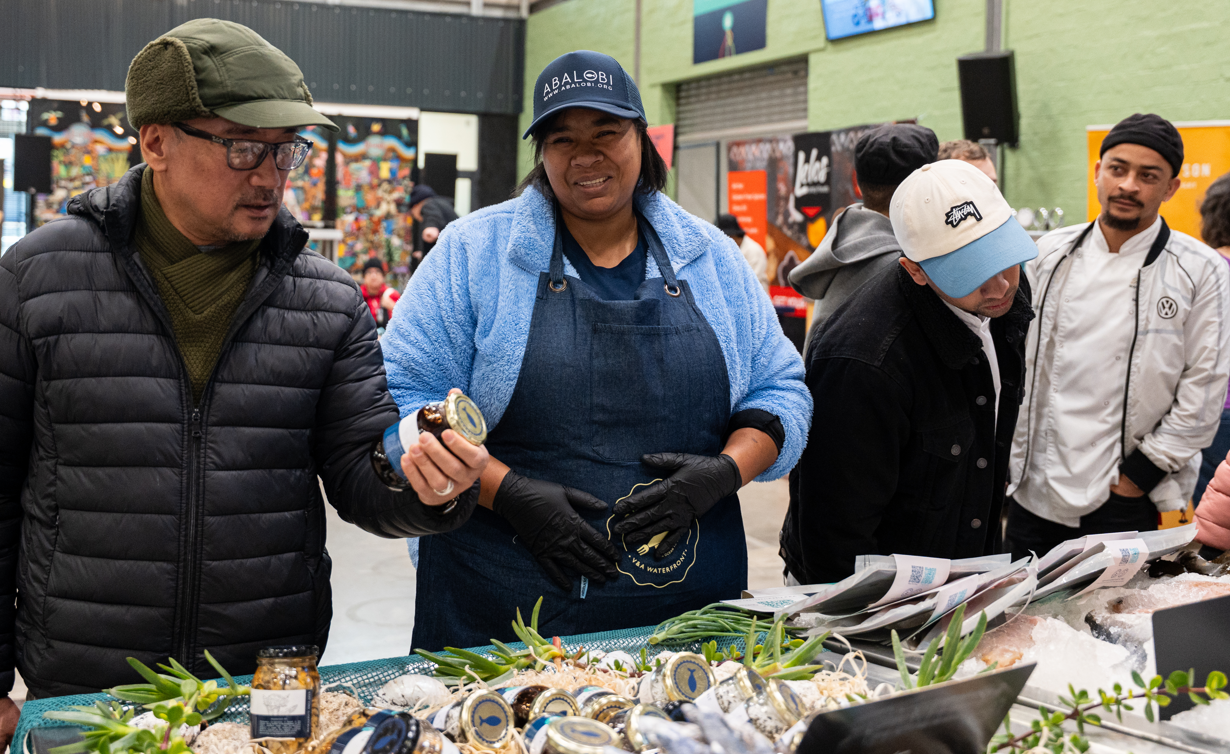
For fishers, this is very personal. One of the biggest challenges for fishers is access to market: “I used to stand on the side of the road in Doringbaai, waiting for passing cars to stop and buy my bream,” said Hahn. So the relationship with Ocean Basket is life-changing: “you can see the improvements [amongst fishers]. They used to talk about food on the table, now they’re talking about upgrading engines, for instance.”
Improvements at the start of the value chain show benefits all the way through. A more secure market “has taught us a great deal,” Hahn said. “I know now I can catch fewer fish for more money if there is a cooler box to keep the fish fresh.”
Frozen fish is the solution to year-round consistency. Fish are seasonal, and supply can be unpredictable. “Fishing is very feast-or-famine,” said Julie Carter from Ocean Jewels when the conversation opened to the floor. “I would like to see chefs buying more frozen fish.” This triggered a valuable conversation. Ryan pointed out that in the past, fresh fish tended to go to the freezer only a few days after being caught when sales slowed down, so frozen fish was often inferior. “Historically, frozen got a bad rap, but that has changed now,” he said. Marco made the point that Ocean Basket’s system is based on frozen. “We take advantage of when there is a feast. We don’t have the back-of-house skill to chop and change menus and species.
“And technology from a freezing, cold-chain perspective has got so much better.”
Kurt echoed this and spoke about his company’s approach to leveraging the best of both. “When fresh is available, our customers get it; but there is a blast-frozen alternative when fresh isn’t available. We’ve been doing it for a decade, and it’s not something that any kitchen should be nervous of. It’s the key to consistency throughout the year.”
Traceability is key. It’s one way to keep at bay the recreational fishers who seek to illegally sell surpluses to offset their costs. Secondly, it’s essential to being sure what it is you’re cooking and serving. Werner from Karibu Restaurant made the point that he was “always excited about Brand SA”, so kingklip was on his menu – but when the kitchen took deliveries, the “kingklip” sometimes turned out to be ling from New Zealand, not the same thing at all. Added Marco: “The fact that we have to check stock at the back door is a red flag about suppliers.”
“Traceability is becoming more important among our customers,” confirmed Kurt. “A big part of our business is exporting fresh tuna. Tuna is tagged with date of capture, vessel and batch. You must be able to do that for all products. We can trace each of the Cape Catch products from source to plate.”
AND REMEMBER THE BOTTOM LINE
Remember, Judy concluded, that fish are animals. In the way we think about this whole industry, we should retain a sense of respect, and see the ocean as something to protect. It is our great privilege to stand for better ways of being.
WHAT’S ON THE CAPE CATCH LIST?
The list will change as fish stocks increase or decrease, and as aquaculture techniques improve, but for now, the Cape Catch list includes:
FIN FISH
SHELLFISH
The Sustainable Seafood Initiative was driven and prototyped by SOLVE@Waterfront and the Two Oceans Aquarium Foundation (TOAF).
ABOUT SOLVE
SOLVE @Waterfront is the V&A Waterfront’s urban innovation platform, designed as a living laboratory that brings together businesses, researchers, government and civil society to develop, test and scale solutions to urban challenges.
ABOUT TOAF
The Two Oceans Aquarium Foundation is the non-profit arm of the Two Oceans Aquarium at the V&A Waterfront. It focuses on ocean conservation, marine research, environmental education, and animal welfare to promote healthy oceans for all.
[1] See this analysis in the Guardian.