

Infinite Streets started in 2019 as a product development, graphics 2D & 3D printing company which upcycled plastic waste to create kitchenware, furniture, sneakers, fabric, medical and engineering industry parts.
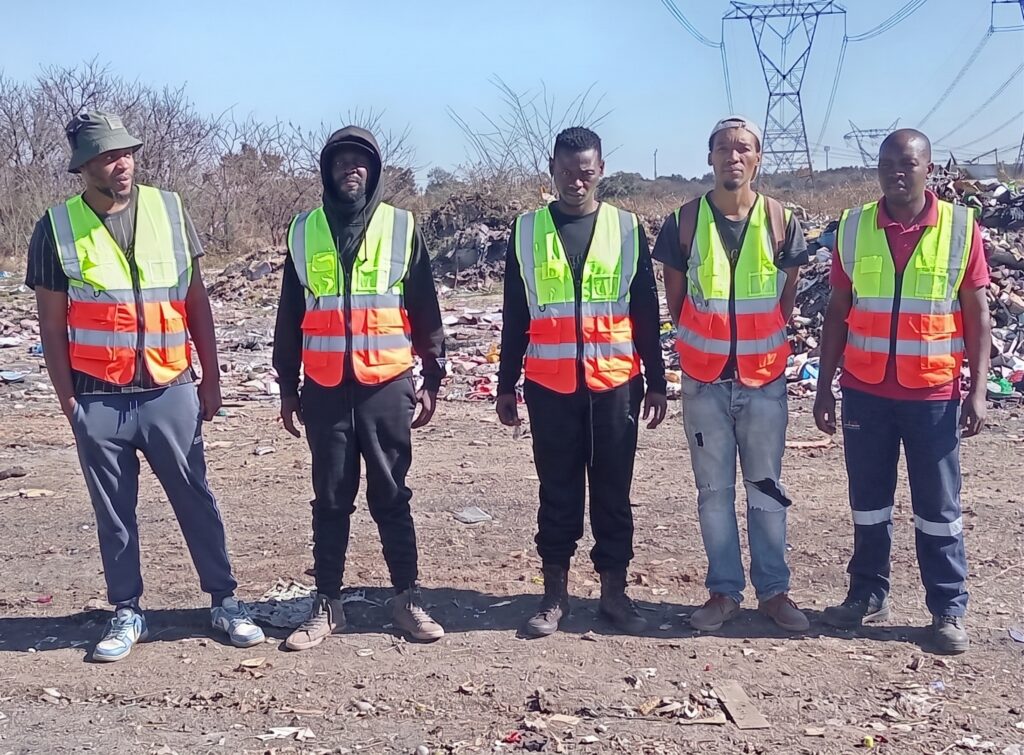
A complementary company the owner registered at the same time is the Vaal River Wetland Ecology, a NPO focused on addressing illicit dumping on landfills and in wetland areas along the Vaal River system. Its founding mandate was environmental remediation: identifying and clearing illegal dumpsites that were degrading wetland ecology and encroaching on landfill boundaries.
Early 2D printing practice centred on sublimation printing — a process made possible by plastic coatings applied to polyester fabric, in which heat transfers dye through a polymer layer into the fabric surface. Working closely with this process shifted how the practice was understood internally: rather than viewing the business purely as a print or design studio, it began to be framed as a plastic science practice, since the outcome of every print job depended on the behaviour of a polymer coating under heat. This reframing — from “printing business” to “plastics practice” — became the conceptual link between the company’s creative origins and its later technical direction.
As the NPO’s dumpsite-clearing work progressed, it surfaced a recurring material: plastic waste. This observation, combined with Infinite Streets’ growing self-identification as a plastics practice, led to the ambition of establishing a buy-back centre — a facility where recyclable plastic could be purchased from waste pickers and community members, formalising the informal waste economy and feeding recovered material back into productive use rather than into landfills or wetlands. This buy-back centre concept, first conceived during the NPO’s early dumpsite work, remained a long-term goal that would only be realised several years later.
Building on its plastics focus, Infinite Streets added 3D printing to its offering. The strategic aim was not simply to offer 3D printing as a service, but to manufacture the company’s own filament, closing the loop between recovered plastic waste and a usable production input. A filament-maker for PET plastics was designed and printed in pursuit of this goal. The attempt was not successful: the company had the fabrication capability to build the machine but lacked the plastics manufacturing knowledge needed to reliably process PET into consistent, extrudable filament. This gap became the catalyst for the next phase of the company’s development — formal technical training. Infinite Streets’ participation in the 2023 Plastics Innovation Challenge, where the company placed in the top five, enabling its founder to embark on the necessary studies.
In 2023 SOLVE introduced Taelo (founder of Infinite Streets) to Mohloli Secondary School, located close to Sharpville in Gauteng. The school forms part of the Gauteng Department of Education’s SOS (Schools of Specialisation) project which addresses critical skill shortages, e.g. Maths, Science, ICT, Engineering, Aviation, Automation, Finance & Hospitality. The aim of these schools is to bridge the gap between matric education and further study / employment.
Mohloli is a Maritime School. The school is located within a wetlands area which is plagued by dumping. Infinite Streets assisted the school to design and develop a hydro powered waste collecting boat, with many of the components being 3-D printed with plastic filament that comes from PET plastics collected in the area.
At the start of 2024, the school experienced a setback when they had a break-in, and their computer equipment was stolen. It was a particular blow coming just weeks before the annual SOS Schools Festival at which schools showcase their innovations.
Taelo made his own computers and 3D print studio available for student use to allow them to still participate. He taught the children how to work with the equipment, and encouraged them to create their own 3D products to sell at the festival. After the formal relationship with the school had run its course, direct engagement with the learners has continued privately, preserving the skills-transfer relationship.
In January 2025 Taelo started on the infrastructure for the long-planned buy-back centre. This work continues, with approvals being secured in August 2026.
Following further training and industry experience, quality control was established as a formal service within Infinite Streets. In April 2026, this QC capability translated into a contract on a bulk water infrastructure project — Infinite Streets’ first major placement of its quality-control service on a large-scale civil infrastructure job, and a direct outcome of the path traced from the 2019 filament-maker failure.
Infinite Streets also now runs an ongoing land rehabilitation programme in Sharpeville, funded through 10% of the company’s income proceeds.
SOLVE involvement beyond the Challenge:
Pitch training – coached Taelo on how to collate and present his business at the final pitch event. Introduced the business to the City of Cape Town to participate in Lagoon Beach water cleaning project tender. Introduced to Moholodi Secondary School; collaboration commenced August ‘23. Sponsored further training – a Thermoplastic Welding course – at Plastics SA; graduated end-24, and Taelo sought to entrench learning and credibility through contract quality control work. He continues this work for HDPE Pipelining and has reached an agreement that enables him to collect the off cuts to feed back into his NPOs.