

The Challenge was founded in 2023 by SOLVE@Waterfront as a component of the V&A Waterfront’s Plastic Strategy; and was then called the Plastics Innovation and Circularity Challenge. It was part of the movement for change, contributing to the strategic pillar of sustainability; and is sponsored by the V&A.
YEAR ONE: PROTOTYPING THE CHALLENGE
For the first iteration, SOLVE partnered with the UK-South Africa Tech Hub, an initiative of the UK Government; and Ocean Hub Africa, a blue economy accelerator; and invited applications from enterprises working in the plastics circularity space. To qualify, applicants needed to be based in South Africa, and to have developed an innovative business/ technological solution to problem plastics.
Prize package
Our prize was a R175 000 cash investment for the winner, with R25 000 for the runner-up; and both were invited to participate into Ocean Hub Africa’s 2023-2024 cohort, its first pan-African accelerator programme.
Entries and judging
Entrants were asked to fill out a form, attach a pitch powerpoint, and share a video telling their story. We received 40 entries.
Judging followed a three-phase process:
In the first instance, internal stakeholders – the V&A and SOLVE – reviewed the entry forms, PPTs and videos of all entrants in order, firstly, to filter out any entrants whose enterprise did not meet the entry requirements; and secondly, to rate them according to a list of pre-determined criteria.
The top 10 entries, along with the criteria sheet, were then sent to the judging panel comprising subject matter experts, along with the criteria. That panel chose their top five entrants, who were invited to present their businesses at a pitch session some weeks hence. In the intervening period, SOLVE invited the finalists to individual online sessions to deal with any questions and concerns, and worked with those who lacked confidence to refine their pitch decks such that they could tell their stories in a tight time allotment.
Candidates from out of town were gifted flight and accommodation arrangements to allow them to travel to Cape Town for the finals; and on Wednesday February 22, the five shortlisted candidates pitched their innovations to the judging panel and a large and highly engaged audience at Ocean Hub Africa’s annual innovation summit, Ocean Innovation Africa (OIA).
The audience
OIA 2023 was attended by 578 delegates, representing 408 organisations, from 59 countries, with almost 90% of them coming from 35 African countries. Daily in-person attendance averaged 285 people; and delegates who were unable to travel to the event could view the sessions online.
The winners
The winner The Litterboom Project, an established waste reclamation innovation, won the Challenge with their new Innovation Hub, established to train and upskill “wastepreneurs” from communities which experience severe plastic waste problems. Participants are equipped with technical skills to create innovative products that have access to market through relationships Litterboom establishes.
The runner-up. Akili Community Evolution, works to provide greater access to the power of computing and digital making, while engaging with pertinent environmental challenges of e-waste and plastic waste countrywide. Akili’s goal is affordable and sustainable computing for everyday needs – they salvage e-waste components to be integrated into “new” computers; and they use fibre from PET bottles and 3-D printing technology to make cases for these computers.
YEAR TWO: BUILDING ON LESSONS FROM YEAR ONE
A key learning from our first year was that entrants focused overwhelmingly on the “plastics” component of the Challenge’s name, while the “innovation” and “circularity” components were under-represented. In the plastics space, there is a great deal of valuable work around diversion through waste recovery, recycling and upcycling. Little of this, however, conforms to the principles of circularity, and there was little real innovation.
Implementing some lessons
In 2024, therefore, we named the next iteration the Circular Innovation Challenge. It was much more explicit, in this naming, that the focus was on initiatives that contributed to the move from a linear to a circular economy in an innovative way. What remained consistently well understood was that the Challenge sought to reduce resource consumption and the generation of waste pollution through innovative approaches.
Another learning was that the accelerator programme offered by OHA, while excellent in and of itself, was not necessarily a great fit for businesses with no direct link to the ocean. Moreover, some small enterprises indicated they simply could not afford the time commitment required in any structured programme. In reassessing the prize, therefore, we made some meaningful changes:
We stressed the opportunity for the winner to test their product or service at the V&A Waterfront (if relevant). With ±25 000 people living or working on the precinct each day, and given the ±26 million visits made to the precinct each year, this presents a rare platform and an excellent sandboxing opportunity.
As before, all finalists would through their participation in the pitch session be afforded a highly relevant platform to talk about their business, and would gain access to a targeted network of related businesses and organisations.
We were, additionally, keen to explore potential pan-African opportunities, so expanded our reach to include Southern Africa. This aligned to the more global perspective of our partner and partial sponsor in this second year, The Vikára Institute.
Entries and judging
The Challenged launched in August 2024, and by closure had attracted 54 submissions from across Southern Africa.
The judging followed the same process as the previous year, with the addition of high-calibre international judges for the final pitch session, courtesy of the relationship with the new partner and sponsor. We also reduced the number of finalists from five to four, in large part to give each finalist slightly more time in the pitch session window.
Audience
At Vikara’s annual Market Systems Symposium (MSS), the pitch session was scheduled for the day’s lunch break. Some initial concerns about thereby losing audience and focus were quickly put to bed: our four finalists presented to a rapt, full audience. Since we had sponsored their attendance at the full MSS, they also had the opportunity to network with over 400 delegates from 65 countries. These delegates represented more than 80 market systems projects, with 65% being from the Southern Hemisphere.
The winner
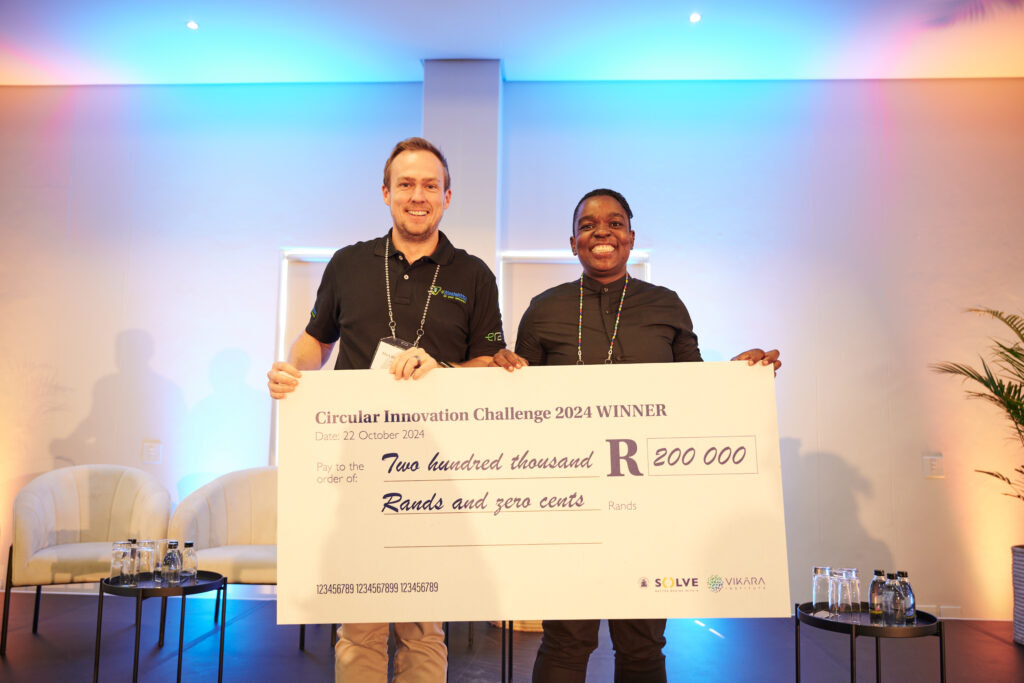
The winner was eWaste Africa which recycles solar panels and other e-waste. While the metals from solar panels are frequently recycled, there has been a challenge around the extensive glass component of these panels which is not conventionally recyclable: e-Waste Africa’s innovation lies in upcycling this glass into interlocking pavers which can be used in pedestrian or motorised vehicle contexts, and which can be coloured.
YEAR THREE
In 2025, happy with the modifications we had tested the previous year, we held to the same format in terms of entries, judging and prizes. However, we had over the course of the Challenge considerably expanded our network of partners in the Circular Economy sector, and with their help, reached many more potential entrants. Perhaps because of this, we saw an improvement in the quality of entries, innovation and expansion to more sectors.
Our partners during 2025 were The Vikãra Institute and The Rock Group. The finalists presented their businesses at the annual Nature and Circularity Week / South African Circularity Summit that took place from 22 to 23 October that was hosted at The Sustainability Institute in Stellenbosch, with just over 250 attendees. The conference was attended by a mix of sustainability professionals, entrepreneurs, NGOs, academics, policymakers and community leaders. By hosting the Pitch Session within the conference, we created a seamless bridge between the theoretical insights of the plenary discussions and the practical ingenuity of the innovator pitches—reinforcing the Summit’s mission to illuminate tangible, actionable pathways toward circularity
The winner
Our winner for 2025 was Gcwalisa; a township-based retail innovation tackling two interconnected challenges: the high “poverty tax” that low-income households pay for everyday goods, and the mounting plastic waste generated by single-use packaging plastics.
YEAR FOUR (TO DATE)
During the 2026 edition we are partnering again with The Vikãra Institute, and will be hosting the final pitch session at their Market Systems Symposium on 21 October.
Changes introduced
There have been two small changes this year.
To increase the relevance of the prize opportunity and to better assess impact, there is a new requirement that entrants must be enterprises that are already trading, i.e. they may not be in the ideation phase, something we previously accommodated. By focusing on slightly more mature ventures, we are better positioned to support acceleration of growth, strengthening of market readiness and unlocking opportunities that can help scale their impact.
This aligns with our goal not only to recognise innovation, but to help promising circular businesses take the next step in their journey.
The second modification is a 25% increase in the cash investment portion of the prize to account for the real impact of a tricky economic environment. Other dimensions of the prize remain unchanged.
NOTE: This case study will be updated as the programme develops.
CONCLUSION
As an inter-connected neighbourhood, we understand that no one has all the answers. We are excited by the incredible work that innovators are doing in the field of circularity, and through this Challenge we seek to shine a light on their efforts, supporting them in maximising important solutions. Our Challenge is a platform for revolutionary thinking and the sharing of ideas that will benefit our planet. We believe that when we act from our better nature, nature gets better.
The circular economy is an opportunity to harness the passion and creativity for which the industry is famed in a way that goes beyond securing its future and allows it to thrive – (World Economic Forum 2019)