

Local glass recycling infrastructure only handles beverage glass. EWaste Africa engineered a custom wet cast milling and binding system to turn hazardous solar panel glass into certified building pavers, reducing the need for virgin sand and stone. This closes the loop on renewable energy streams, reduces carbon emissions, diverts large volumes of waste away from landfills, creates green jobs and reintroduces valuable materials into productive use. The interlocking eco-pavers earned the Global GreenTag Bronze certification in September 2025, allowing them to be used for commercial Green Star credits.
Where was your business when you entered the Challenge – and how have things evolved?
We launched a dedicated solar recycling plant in 2023 and began prototyping interlocking eco-pavers to process complex photovoltaic glass locally. These eco-pavers feature up to 40% recycled glass and have a robust 10.5 MPa compressive strength. We operated two primary licensed facilities in KwaZulu-Natal and Gauteng, plus a consolidation hub in the Western Cape.
At the time of the 2024 Challenge we were managing end-of-life recycling requirements for over 300 corporate clients navigating South Africa’s strict landfill bans and EPR regulations. Our impact was real: we reduced corporate environmental footprints by 150 tons of CO2 equivalent and saved 729 MWh of energy in the 2023 cycle, and doubled documented carbon mitigation and energy savings during the 2024 cycle due to rising corporate demand. We have diverted about 4 000 tonnes of e-waste from landfills over a decade, saving over 1 500 tonnes of historical carbon emissions.
Since the challenge, we have expanded the national network with an imminent third facility in Liliaton (Gauteng) and a licensed facility planned for the Atlantis SEZ in 2028. We have achieved ISO 45001 certification for Occupational Health and Safety, complementing existing ISO 9001 and 14001 standards. We have grown the national team to 65 full-time staff members, securing stable employment within the green economy.
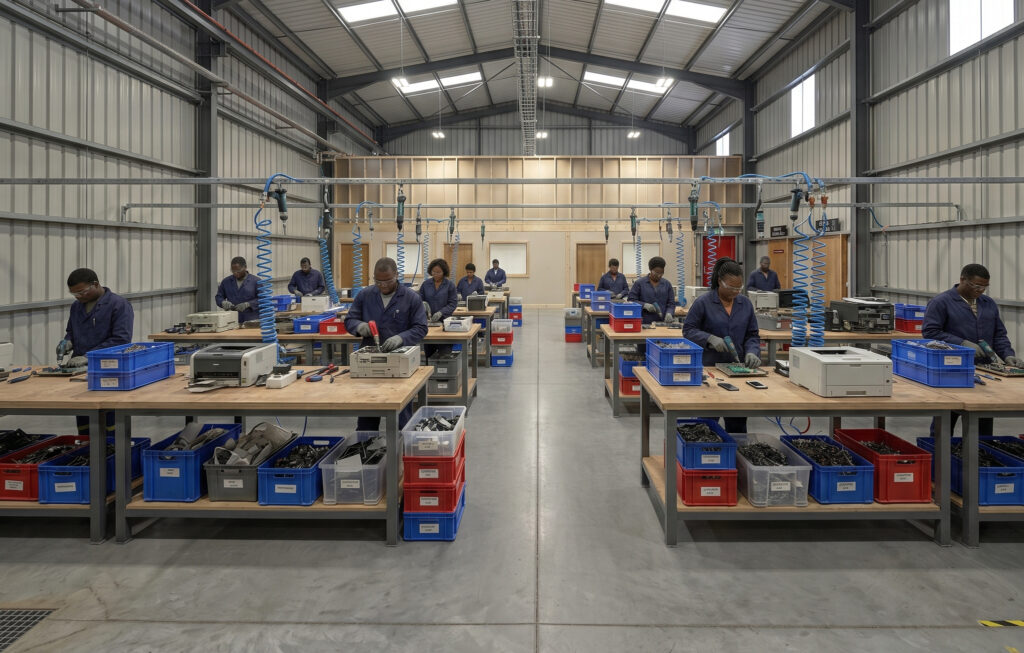
On the people front, we have rejected giant automated shredders in favour of trained human technicians. Manual disassembly allows for the safer isolation of fragile hazards (like mercury backlights and lithium batteries) while creating meaningful, green livelihoods. In practice, our process creates five to seven times more jobs per ton of e-waste. We’ve focused on tomorrow’s leaders, with over 60% of the full-time workforce under the age of 36. We’ve also validated that a Level 1 B-BBEE company can successfully merge strict environmental compliance with profitable local industrial manufacturing.
On the collection side, we have rolled out retail drop-off containers in partnership with Pick n Pay, Shoprite, and ERA NPC, expanding to over 200 public collection points.
What’s next?
Our strategic roadmap is taking us towards an annual processing target of 10 000 tonnes of e-waste and 200 green jobs by 2030.
There’s also some technical innovation: we are constructing an in-house LPX plant to safely isolate mercury and recover valuable rare earth metals from lighting and screen waste.
Any advice you’d give to businesses thinking about applying?
Target specific, measurable market bottlenecks or legal challenges. Ensure the business model explicitly links environmental metrics with regional social impact and job creation. Secure independent validation and maintain full traceability, as B2B buyers require ironclad compliance data.
SOLVE involvement beyond the Challenge:
Introduction to V&A to explore opportunities for testing the pavers. Logistical challenges have prevented this so far, but we remain optimistic about hosting them on the property. Encouraged participation in the World Economic Forum’s Challenge. Published their story in the V&A’s Change Chapters in November 2025.