Mental fortitude and SMME success
If there’s one thing that characterises the world we live in today, it’s uncertainty. In the past five or so years we’ve had to navigate supply-chain disruption and economic contraction driven by Covid-19; endure the misery of live-streamed wars in Europe and the Middle East; work around electricity and water supply failures at home; and watch aghast the intensely divisive shenanigans on the part of some of the world’s leaders which have led to trade wars and market disruption. That’s on top of usual market pressures, and whatever is happening on a personal level for any of us.
If you’ve not felt destabilised, you’re rare. Certainly, some SMMEs have thrown in the towel, unable or unwilling to continue swimming against what seems to be a relentless and growing current.
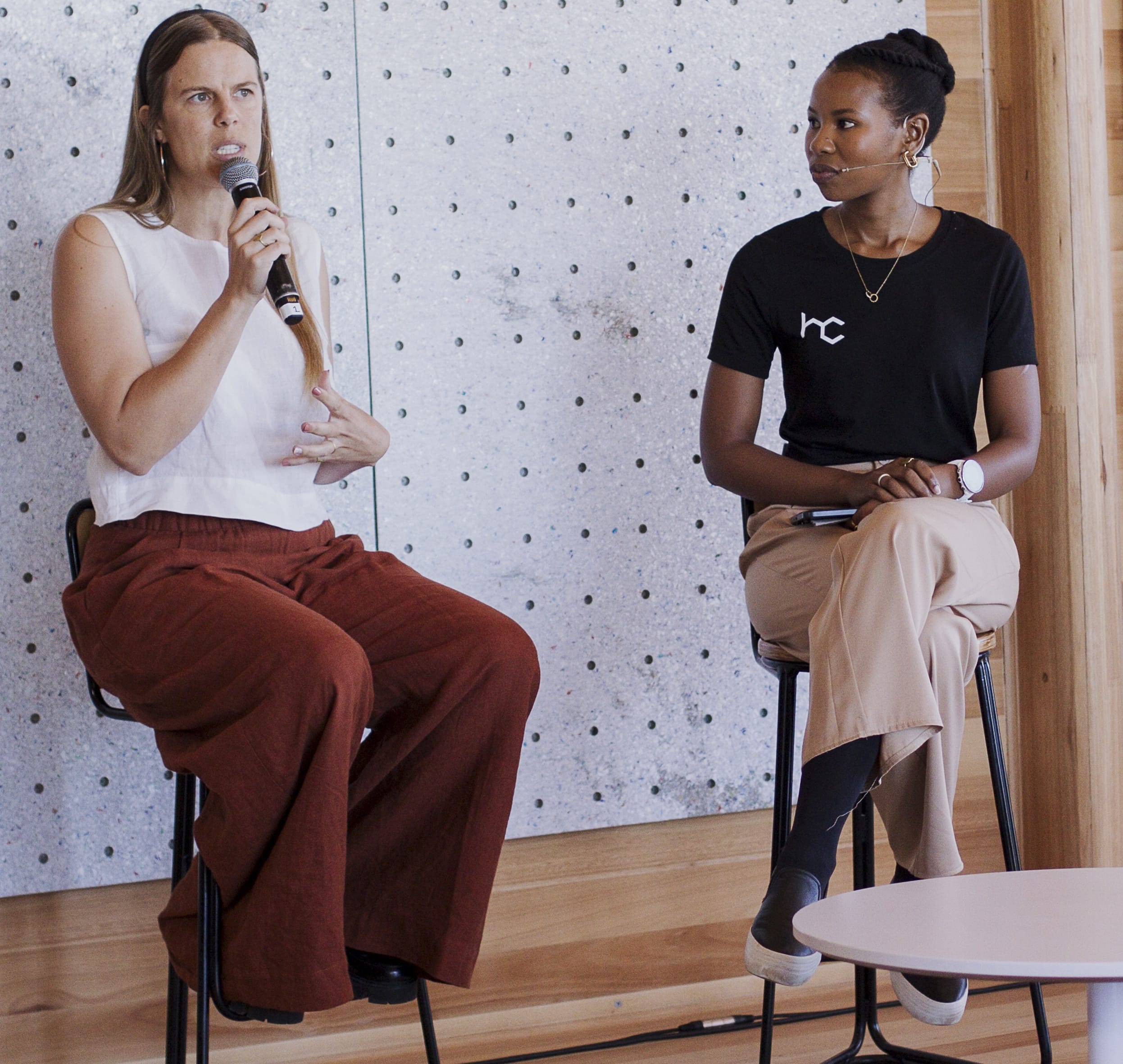
So Nicola Lazenby’s (above, in deep conversation with Heavy Chef’s Nasi Hako) talk at March’s Learning Lunch on the subject of “Mindset and mental fortitude”, hit a nerve.
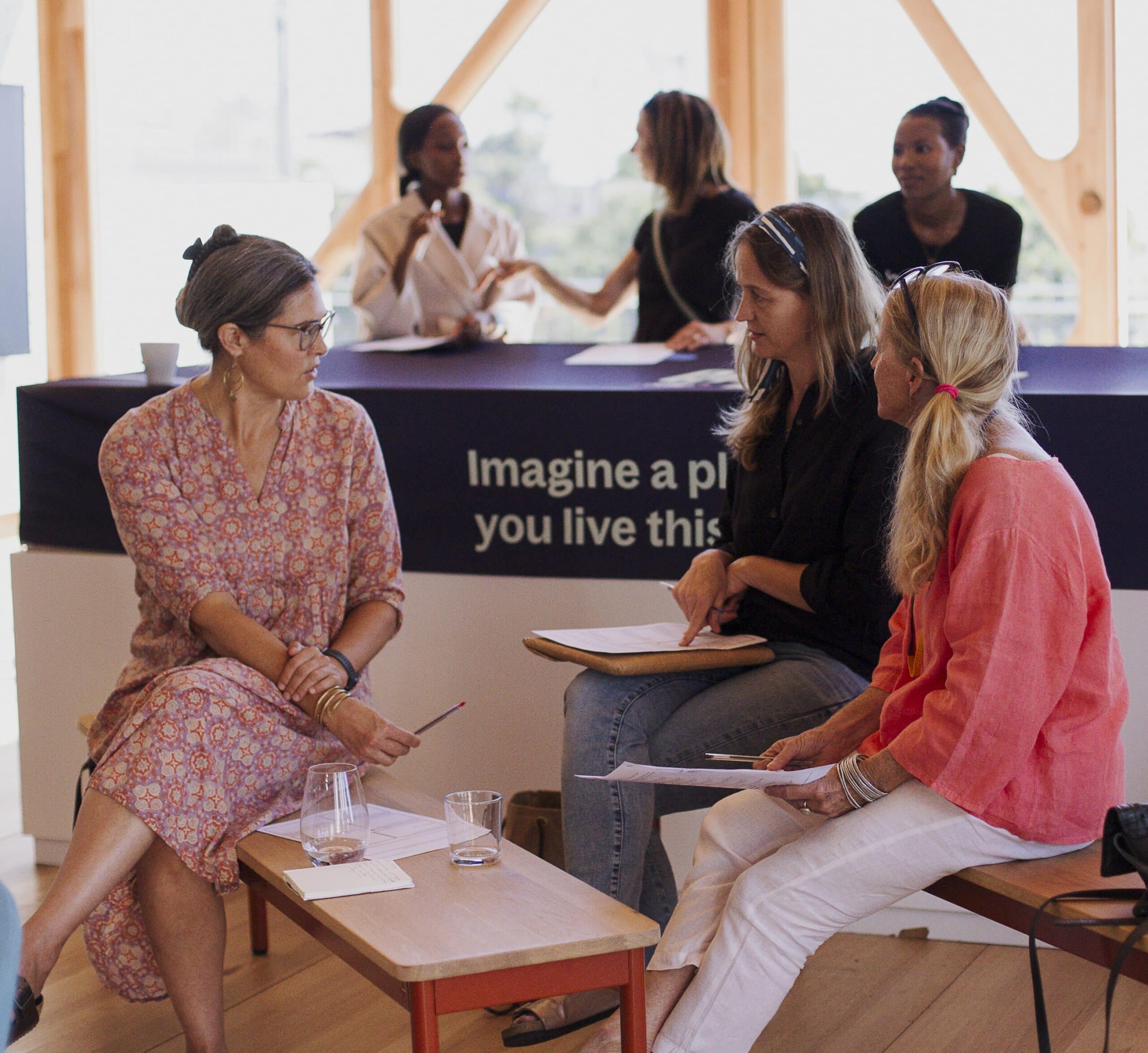
The session, held in partnership with Heavy Chef, is part of a series intended to bring SMMEs across the V&A Waterfront’s precinct together in a co-learning space, building community and mutual problem-solving. Nicola is a registered counsellor and therapist whose practice brings her very close to the SMME community.
When something goes wrong in their business, she explained, entrepreneurs can experience this as akin to an existential threat. Business challenges are personalised: “if my business is doing badly, I’m failing as a human being”. When we’re in fight, flight or freeze mode, our physiological response impact the way we think, feel and respond. The pre-frontal cortex (where higher-level thinking and emotional regulation happen) closes down in times of fear. This is not, Nicola pointed out, a good place to make decisions from: we want to be making decisions from a place where we’re thinking clearly and connecting to purpose.
That’s why the development of mental fortitude, or the ability to process obstacles in such a way that we can self-regulate, is essential not only to mental peace, but to business survival.
The top five worries that emerge in surveys conducted by the V&A among SMMEs on the precinct are:
- Inconsistency in sales
- Staff issues
- Cashflow
- Marketing inconsistency and difficulty
- Time overload
These are perhaps predictable worries, and it is every business owner’s job to find ways to work with them. The feelings and thoughts they elicit are uncomfortable. Mental fortitude is about acknowledging these feelings without feeling pressed to jump in to fix the feelings; and practising self-compassion to stop self-critical pressure building up and overwhelming us.
“Self-compassion is self-parenting,” Nicola said. “We often have a critical voice about our own pain. We’re irritable with ourselves for feeling tired, for being anxious. The pain isn’t optional, but the suffering is optional. Suffering comes from attributing negative feelings about ourselves to the pain.”
She recommended what she called “a container”, an imaginary box where you place any thoughts and feelings that are interfering with your ability to move through the day. Things are safe there until you are able to come back and look at them. “That way, you honour the realities of the difficulties, without letting them drive the bus.”
When we practise self-compassion, she pointed out, we understand that we are in charge and we are therefore less likely to lash out. If we can sit with, for instance, anger or insecurity in ourselves, we are likely to be more gentle with others.
“My guiding principle is one of wholeness,” Nicola said. “The roots of the words healing and whole are the same. When I can make a decision from a place of wholeness, the outcome is healing.”
THE DISCOMFORT OF INTROSPECTION
Nicola shared a story that she attributes to defining her world view. She was in a place, she said, where she “wanted to suffer. So I sold my things to walk very far, and suffer. It was a rite of passage: I was moving from one way of being into something new and undefined. On that long walk I had no signal, nothing to reflect myself, and all 12 things that I owned were in my backpack. I had no attachment to anything.”
That journey was a four-month solo walk along part of the Pacific Crest Trail, from Mexico to Canada.
“Into that space other voices could speak – things I was hiding from, or didn’t want to recognise. Other voices from the natural world came through – and it became an immense resource for me to realise that I’m not separate from nature. I realised I could afford to look at myself.”
But it’s difficult to look at ourselves square on. “I did need help. I did go into therapy and learned tools and tricks that helped me tolerate looking at myself.”
Entrepreneurs have all the excuses in the world not to look inwards. “As entrepreneurs there is always something to do; it’s very easy to avoid looking at yourself. It takes intention, and it takes support (we can be really mean to ourselves). It can be too hard alone. One of our cognitive distortions is that if we’re being critical or cynical, we are being realistic. But that’s not necessarily true. When we do that, we’re being narrow; we need to widen our thinking.”
Drawing from the theories underpinning Cognitive Behavioural Therapy (CBT) Nicola had some useful – and comforting – ideas to share: Emotions are very rational and very ordered, so if you know how to look at them, they are easy to understand. Anger is usually a secondary emotion (driven by hurt, or fear). And, for business owners who all have to balance their left and right brains, it is useful to hear this: Criticism and creativity are like evil twins.
Generously, Nicola shared a thought-mapping process that she highly recommends entrepreneurs adopt as a counterweight to self-critical negativity.
- Write down, in neutral terms (avoiding adjectives) the event that has triggered you – what you saw, or what you heard.
- Now write down what the core feeling was following the event – were you angry (mad)? Sad? Glad? Afraid? And how did that manifest in your body – a heaviness in your chest, a sick feeling in your stomach?
- If you were counselling someone else who had those feelings, what would you want to give them? Compassion, perhaps, or comfort? Just an acknowledgement that you understand (connection?) What, in other words, does this feeling need?
- Now look at (list) what Nicola calls the “ants” – the automatic negative thoughts that arise, e.g. “something is wrong with my business”…
- … and also note the alternative plausible thoughts that might apply, e.g. “uncertainty does not mean failure”.
- When you’re in “ant” mode, how does this affect your behaviour? E.g. Would it send you into overdrive/overwork? Would you panic-drop your prices? Change your strategy? Hurl yourself into marketing?
- Instead, focus on what CBT calls “behavioural activation” – scrutinise what evidence there actually is to drive action – and based on the evidence alone, rather than the feelings, what is the next step?
As Fred Roed of the Heavy Chef team said in his closing: You start with feelings, and you finish with facts. That is part of the duality that we as entrepreneurs have to embrace.
Try it. Come to our sessions, and let us know how it goes.
ABOUT THE SMME CLUSTER:
SMMEs work in a famously challenging social and economic environment. The V&A Waterfront’s SMME Cluster, which drives the Learning Lunches, is about establishing a mutual support system for SMMEs in our network, and working together around shared challenges and opportunities. Our goal: a more resilient, innovative and flourishing SMME community.
ABOUT HEAVY CHEF
In the discussion after Nicola’s talk, one of the attendees testified about how, after 17 years of going solo, she had joined an entrepreneur network, and what a massive difference that support had meant both personally and professionally. “We are not alone,” she said. “When we share things, we feel lighter. It can be the difference that allows you to move on.”
This is a direct reflection of the Heavy Chef research finding that the frequency and quality of your interactions with other entrepreneurs is closely linked to the success of your business. Heavy Chef is a learning community for entrepreneurs (the name comes from the saying “never trust a skinny chef”). It aims to inspire entrepreneurs to start, then empower them to succeed. It runs learning programmes for hundreds of entrepreneurs each year, and has a community of 50,000+ entrepreneurs. V&A Waterfront’s Learning Lunches are among its programmes.